

You have been told your content needs a good readability score. Maybe Yoast SEO is showing you a red light. Maybe you read that Google rewards easy-to-read content. Maybe you simply want to know whether your writing is too complex for your target audience.
But what does a "good" readability score actually mean — and does it really affect your SEO rankings? The answer is more nuanced than most guides will tell you. In this post we will break down exactly what readability scores mean, what score to target based on your specific audience and content type, and the honest truth about how readability relates to SEO.
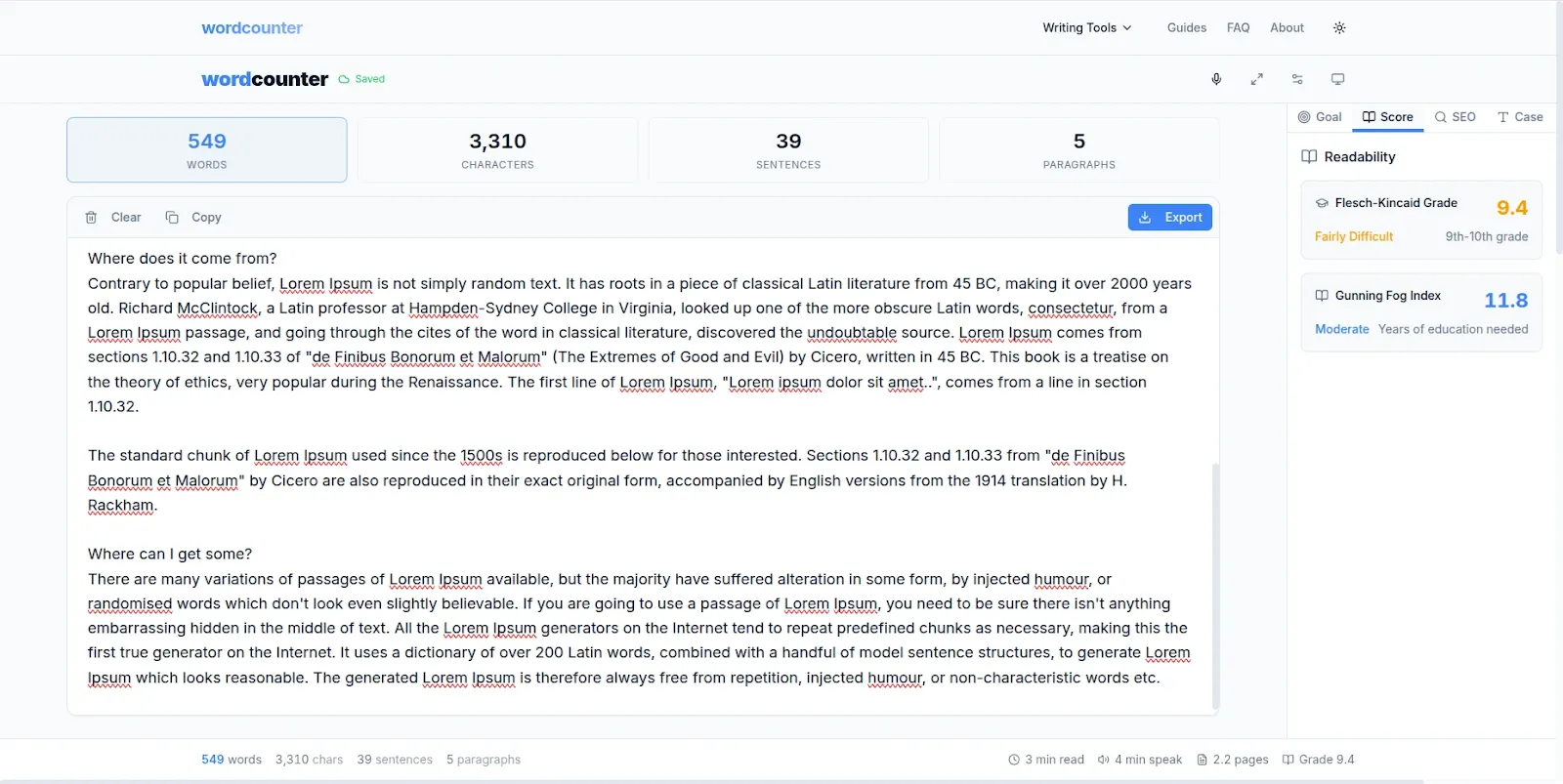
WordCounter — Check your readability score free. No signup, no upload required.
What Is a Readability Score?
A readability score is a numerical measure of how easy a piece of text is to understand. The most widely used formula is the Flesch Reading Ease score — developed in 1948 and still the standard used by editors, SEO tools, publishers and accessibility checkers today.
The formula considers two main factors: average sentence length and average number of syllables per word. Shorter sentences and simpler words produce higher scores — meaning easier reading. Longer sentences and complex vocabulary produce lower scores — meaning more difficult reading.
The score runs from 0 to 100:
90 to 100 — Very Easy. Understood by an average 11-year-old. Short sentences, everyday vocabulary. Think children's books and simple instructions.
70 to 90 — Easy. Conversational English comfortable for most adults. The language of popular newspapers, consumer blogs and social media.
60 to 70 — Standard. Plain English for ages 13 to 15. The recommended range for most web content, how-to guides and general audience blog posts.
50 to 60 — Fairly Difficult. Requires some educational background. Suitable for professional content aimed at educated adult audiences.
30 to 50 — Difficult. Best understood by university-educated readers. Standard for academic papers, legal documents and specialist professional writing.
0 to 30 — Very Difficult. Best understood by graduates with subject expertise. Typical of scientific journals, complex legal texts and technical documentation.
What Is a Good Readability Score for SEO?
This is the question most bloggers ask — and the honest answer is: it depends on your audience. But here are the practical targets for the most common content types:
General audience blog posts and web content: Aim for a Flesch Reading Ease score of 60 to 70. This is the Standard range — accessible to the broadest possible online audience without feeling oversimplified. Most successful SEO blog posts fall in this range.
Marketing copy and landing pages: Aim for 70 to 80. Marketing copy needs to be immediately clear and compelling. Complex sentences slow down decision-making and reduce conversion rates. The easier your copy is to read, the faster visitors understand your value proposition.
Technical content and developer documentation: A score of 40 to 60 is acceptable when your audience has the subject expertise to follow more complex explanations. Trying to oversimplify genuinely technical content can make it less useful to its intended audience.
Academic and legal writing: 20 to 50 is standard. These formats prioritize precision over accessibility by convention — a legal contract that reads like a blog post would lose the precision that makes it legally effective.
Email newsletters: Aim for 65 to 75. Emails are read quickly, often on mobile, in contexts of low attention. Plain, direct language dramatically outperforms formal writing in email engagement metrics.
Does Readability Directly Affect SEO Rankings?
Here is the honest, research-backed answer: readability is not a confirmed direct Google ranking factor — but it strongly influences the signals that Google does measure.
A study analyzing 756,297 pieces of ranking content found no direct correlation between readability score and search ranking position. Interestingly, the same study found that content ranking in Google's top 30 positions averaged an 11th-grade reading level — suggesting Google does not systematically favour simpler content over complex content in its ranking algorithm.
However, this does not mean readability is irrelevant to SEO. The connection is indirect but powerful:
Bounce rate: When readers arrive on your page and find the content hard to read, they leave quickly. High bounce rate signals poor content quality to Google and pushes rankings down over time. Easy-to-read content keeps readers on page longer — improving this signal.
Dwell time: Google measures how long visitors stay on your page after clicking from search results. Content that is easy to read and scan keeps readers engaged for longer — a positive signal for content quality.
Featured snippets and voice search: Google strongly favours content written at a Grade 6 to 9 reading level for featured snippets and voice search responses. Clear, direct answers in plain language are far more likely to be pulled for answer boxes than dense, complex explanations.
Mobile performance: With the majority of web content consumed on mobile, short sentences and short paragraphs are not just stylistic preferences — they are essential for retaining mobile readers who scan rather than read in full.
In short: readability does not directly move your ranking needle — but poor readability causes the reader behaviour signals that do move it, in the wrong direction.
How to Check Your Readability Score for Free
WordCounter includes a free built-in readability checker that gives you your Flesch Reading Ease score, grade level, average sentence length and syllable count — all instantly in your browser with no signup and no upload required.
Go to wordcounter.nzuki.com, select Readability Checker from the Writing Tools menu, paste your content and your score appears immediately. Your text is processed locally in your browser — nothing is ever uploaded to any server.
WordCounter also gives you word count, character count, keyword density, reading time and SEO analysis alongside your readability score — making it the most complete free writing analysis tool available for bloggers and content creators. See our full guide on how to use WordCounter's free readability checker for detailed steps.
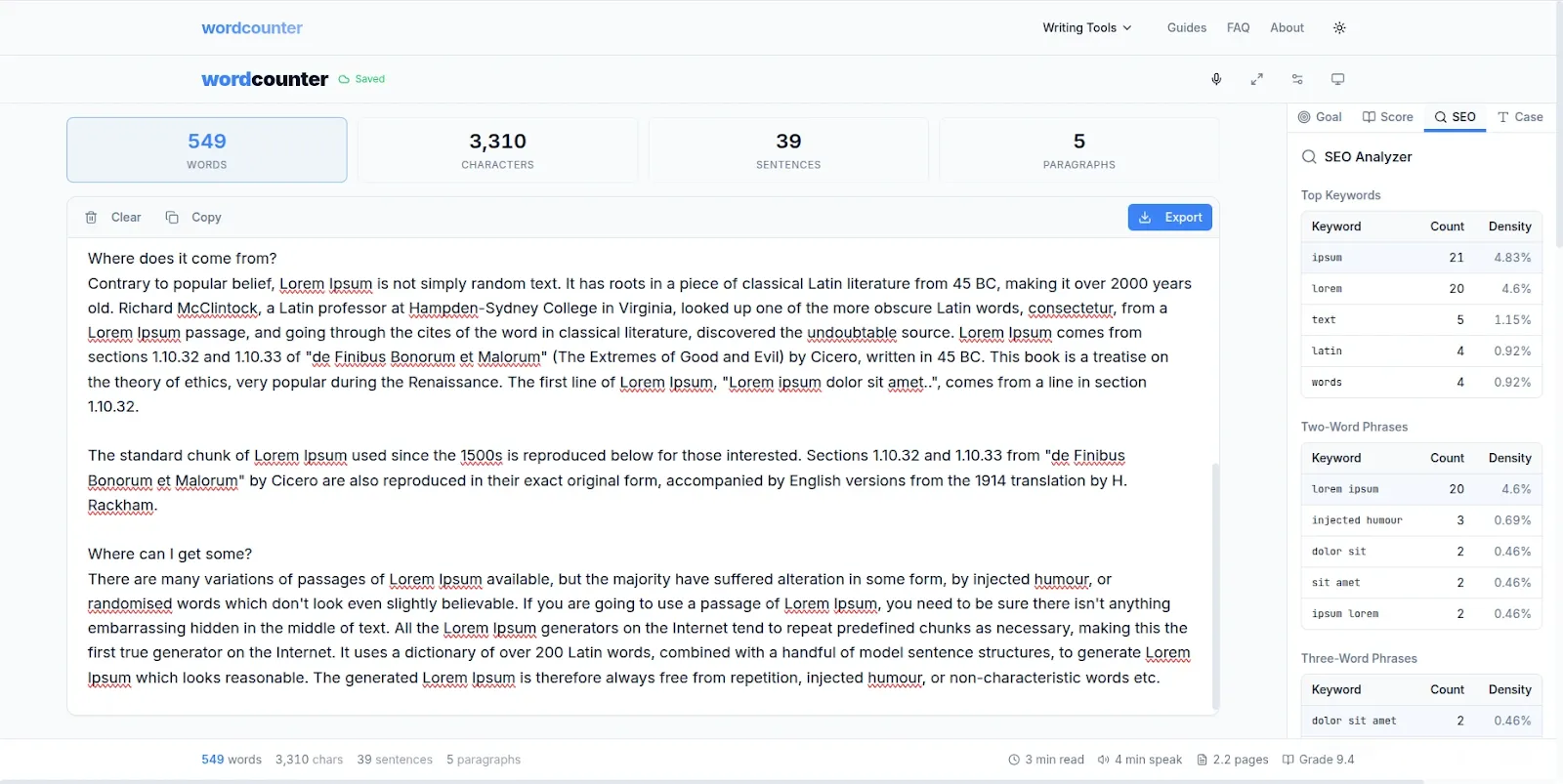
Check your readability score instantly in WordCounter — free, private, no account needed.
Practical Tips to Hit Your Target Readability Score
Shorten your sentences first: Sentence length is the single biggest driver of readability score. Aim for an average of 15 to 20 words per sentence. When you write a sentence longer than 25 to 30 words, look for a natural split point and break it into two.
Replace multi-syllable words with simpler alternatives: Every time you find yourself using a word like "demonstrate", "utilize" or "facilitate" — replace it with "show", "use" or "help". Simpler words are not less intelligent. They are more effective communication.
Write in active voice: Active voice produces shorter, clearer sentences. "We built the tool" is cleaner than "The tool was built by us." Passive voice adds syllables, adds words and reduces clarity — lowering your readability score on all three dimensions.
Break up long paragraphs: Online readers scan before they read. Long blocks of text are visually intimidating on screen and especially on mobile. Keep most paragraphs to 2 to 4 sentences and use subheadings every 200 to 300 words to help readers navigate.
Do not over-optimize for score at the expense of accuracy: Your readability target is a guideline, not a rule. If your content covers a technical topic that genuinely requires complex vocabulary, prioritize accuracy for your audience over hitting an arbitrary score number. A specialist audience finds appropriate technical language more readable — not less — than oversimplified alternatives.
Frequently Asked Questions
Is a higher Flesch Reading Ease score always better for SEO?
Not necessarily. A higher score means easier reading — which is better for general audiences but may be too simple for specialist or professional audiences. The right score depends on who you are writing for. A blog post for a general consumer audience should score 60 to 70. A white paper for financial professionals can score 40 to 55 without this being a problem.
Does Google use readability score as a ranking factor?
Readability is not a confirmed direct Google ranking factor. Research analyzing hundreds of thousands of ranking pages found no direct correlation between readability score and ranking position. However, readability strongly influences bounce rate, dwell time and mobile engagement — all of which do influence rankings indirectly.
What readability score does Wikipedia aim for?
Wikipedia content typically scores around 50 to 60 on the Flesch Reading Ease scale — the Fairly Difficult range. Wikipedia targets a broad but educated general audience covering complex topics, which explains why it scores lower than most blog posts while remaining highly readable for its intended audience.
How do I check my readability score for free?
Use WordCounter — a free browser-based writing tool that checks your Flesch Reading Ease score, grade level, word count, keyword density and reading time simultaneously. No signup, no upload and no account required. Your text is processed entirely in your browser.
Should I use readability score or grade level to measure my content?
Both measure the same thing from different angles. Flesch Reading Ease gives you a score from 0 to 100 where higher is easier. Grade level (from the Flesch-Kincaid Grade Level formula) tells you the US school grade level needed to understand your content. For blog content targeting a general audience, aim for Grade 6 to 9 — equivalent to a Flesch Reading Ease score of approximately 60 to 80.
Conclusion
A good readability score for SEO blog posts is a Flesch Reading Ease score of 60 to 70 — the Standard range accessible to the broadest online audience. For marketing copy aim for 70 to 80. For technical or professional content 40 to 60 is acceptable.
Readability is not a direct Google ranking factor — but poor readability causes high bounce rates, low dwell time and weak mobile performance that do affect rankings. Write for your reader first, check your score as a quality signal and use it to identify specific sentences and paragraphs that can be simplified.
Check your readability score for free at wordcounter.nzuki.com — alongside word count, keyword density, reading time and SEO analysis, all in one browser-based tool with no signup required.
Also check our related writing guides: free readability checker online, free keyword density checker and free word counter for essays.
🚀 Need a Professional Website or Custom Tool for Your Business?
VelocityAI Solutions builds AI-powered websites, mobile apps and business automation tools for businesses in Nairobi and beyond — at startup-friendly prices.
✅ Web Development | ✅ Mobile Apps | ✅ Business Automation | ✅ Cybersecurity
🌐 velocity-ai-solutions.nzuki.com
💬 WhatsApp: +254 735 644 100
📩 info.nzuki@gmail.com


0 Comments